From the reading room · 22 Apr 2026
Flumist: A Needle-Free Flu Vaccine for Australian Children
By Nick Buete
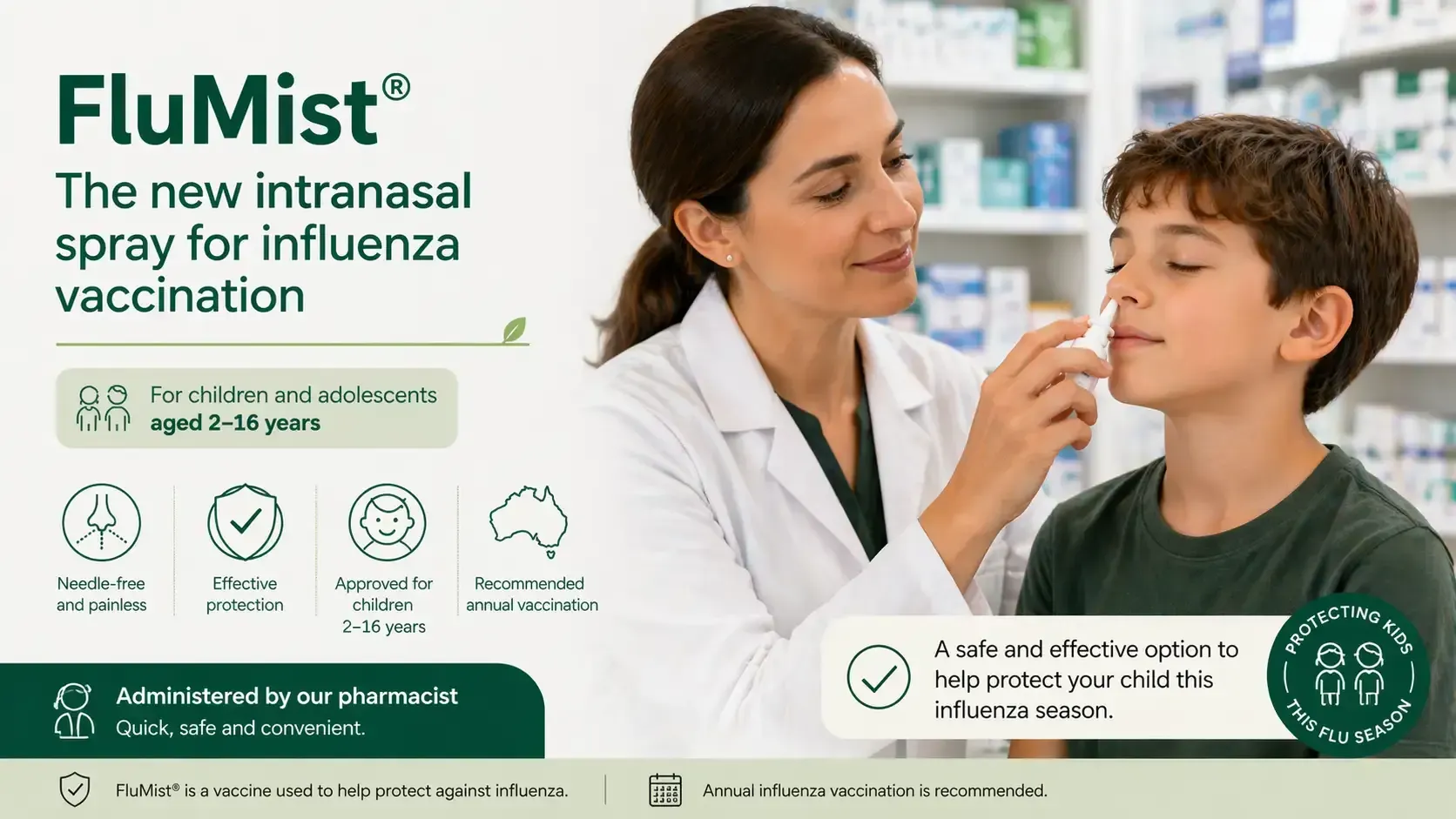
Flumist: A Needle-Free Flu Vaccine for Australian Children
For many Australian families, the annual flu vaccination is a small moment of dread — especially for children who are frightened of needles. Flumist is a nasal-spray influenza vaccine now registered by the Therapeutic Goods Administration (TGA) in Australia for children and adolescents aged 2 to under 18 years. Because it is given as a gentle spray into each nostril instead of an injection, Flumist may be a helpful option for kids with needle phobia and for families who have struggled with flu-season visits in the past.
This article is a plain-language overview: what Flumist is, who it is suitable for, who should not have it, and how it fits with the standard National Immunisation Program (NIP) schedule. It is general information only — your pharmacist or GP can help work out whether Flumist is right for your child.
Quick answer
What it is: Flumist is a live attenuated, quadrivalent influenza vaccine given as a nasal spray.
Approved ages: Children and adolescents aged 2 years to under 18 years.
Free under the National Immunisation Program: Eligible children aged 2 to under 5 years in NSW.
Privately available: Children up to 16 years of age.
Not suitable for everyone: Children with certain medical conditions should have an intramuscular (injected) flu vaccine instead — see the list further down.
What is Flumist?
Flumist is a live attenuated influenza vaccine (LAIV). It contains four strains of flu virus that have been weakened so they cannot cause flu illness, but can still prompt the body to build protection. A small amount of liquid (about 0.1 mL) is sprayed into each nostril — a total dose of 0.2 mL — with no needle involved.
Because the vaccine is delivered to the lining of the nose (where flu usually enters the body), it helps build a mucosal immune response in addition to the whole-body response you get from an injected vaccine. Flumist has been used for many years overseas, including in the UK's childhood flu program, and is now registered for use in Australian children and adolescents.
Who is eligible?
TGA-registered age range: 2 years to under 18 years of age.
Free under the NIP in NSW (2026): Children aged 2 years to under 5 years who are otherwise eligible for a funded flu vaccine can receive Flumist at no cost. This sits alongside the existing annual flu vaccination for children in this age group, which is NIP-funded nationally.
Private access: For children older than 5 years and up to 16 years of age, Flumist is available privately, meaning families pay for the vaccine themselves. A consultation with the pharmacist or GP is recommended first to confirm it is suitable for your child.
The NIP also continues to fund the usual injected flu vaccine every year for groups at higher risk — including pregnant women, Aboriginal and Torres Strait Islander people aged 6 months and over, people aged 65 and over, and people with certain medical conditions. The injected vaccine remains the right option for most people outside the Flumist age range.
Benefits of a needle-free option
Less distress for needle-phobic children. Needle fear is common in kids and can lead to vaccines being delayed or missed altogether. A nasal spray can make the whole appointment calmer and easier.
Quick and simple to give. A brief spray into each nostril — most children find it tolerable, even if it feels a bit unusual.
No sore arm afterwards. Unlike an injection, there's no needle-site soreness, bruising, or bandaid required.
May support broader immunity. Because it's given where flu enters the body, LAIV helps trigger immunity in the nose and throat lining — an area an intramuscular vaccine doesn't reach directly.
Both Flumist and the injected flu vaccines are considered acceptable options for eligible children. The best choice is the one the child actually receives — and for some families, the nasal spray is the difference between getting vaccinated and not.
Possible risks and side effects
All vaccines can cause side effects, and most are mild and short-lived. With Flumist, the more common side effects include:
Runny or blocked nose
Mild sore throat
Headache
Reduced appetite or mild tiredness
Low-grade fever
Serious reactions are rare. As with any vaccine, there is a very small chance of a severe allergic reaction, and staff administering vaccines are trained to recognise and manage this. If your child develops breathing difficulty, a widespread rash, or severe wheezing in the hours after vaccination, seek urgent medical care.
Who should not have Flumist?
Because Flumist contains weakened live virus, it isn't suitable for everyone. Generally, Flumist should be avoided — and an injected flu vaccine considered instead — in children who:
Have had a severe allergic reaction to a previous dose of Flumist or to any of its ingredients
Are significantly immunocompromised (for example, due to certain cancers, transplant medications, or other conditions affecting the immune system)
Live with, or regularly care for, someone who is severely immunocompromised and requires a protected environment
Are currently taking aspirin or salicylate-containing medicines (due to a rare risk of Reye's syndrome)
Have severe asthma, are actively wheezing, or have had a recent serious asthma flare-up
Are younger than 2 years of age
If your child has a cold, heavily blocked nose, or is unwell on the day, it's usually best to reschedule — a blocked nose can interfere with how the vaccine is absorbed. If you're unsure whether Flumist is appropriate for your child, please speak with your pharmacist or GP before booking.
How many doses does my child need?
In most years, children need one dose of flu vaccine per year. However, there is one important exception:
Children aged 6 months to under 9 years who are receiving a flu vaccine for the very first time should receive two doses at least 4 weeks apart. From the following year, they only need one dose annually.
This two-dose rule applies whether your child has the injection or Flumist, and it's an important detail for new-to-vaccine families.
What to expect on the day
Before: Let the pharmacist know about any allergies, current medications (including aspirin), asthma history, or recent illness. A short screening chat helps confirm Flumist is the right choice.
During: Your child will sit upright. The pharmacist will spray half the dose into each nostril. Normal breathing is fine — your child doesn't need to inhale deeply or sniff hard.
After: We'll ask you to stay in the pharmacy for a short observation period, as we do with any vaccination. If your child sneezes or has a runny nose straight afterwards, the dose still counts — the vaccine is absorbed quickly.
Frequently asked questions
Is Flumist as effective as the flu shot?
For eligible children, clinical studies have found Flumist offers comparable protection against influenza to the injected vaccine. Both are considered suitable choices for healthy children within the approved age range.
Can Flumist give my child the flu?
No. The flu viruses in Flumist are weakened and cannot cause influenza illness. Some children get mild cold-like symptoms, such as a runny nose, which is part of the body's immune response — not the flu.
Can Flumist be given at the same time as other vaccines?
In most cases, yes. Flumist can usually be given on the same day as other routine childhood vaccines. Let the pharmacist or nurse know what else is due so this can be checked for your child.
My child has mild asthma. Can they still have Flumist?
Many children with well-controlled mild asthma can receive Flumist, but this needs to be assessed individually. Children with severe asthma, active wheezing, or a recent asthma flare-up should have the injected vaccine instead. Your pharmacist or GP can help decide what's safest.
My child has an egg allergy. Is Flumist safe?
Most children with egg allergy can safely receive influenza vaccines, including Flumist. If your child has had a severe reaction to egg or to a previous flu vaccine, please let us know in advance so this can be reviewed carefully.
Does a runny nose or sneezing after the spray mean it didn't work?
No. The vaccine is absorbed very quickly. Sneezing, sniffing, or a runny nose straight after the dose does not mean a repeat is needed.
Arranging a Flumist appointment at ISPHH Albury Compounding
Availability of Flumist can vary through the flu season. To check current stock and arrange an appointment time that suits your family, please call ISPHH Albury Compounding on (02) 6023 3666 or email gardens@awardpharmacies.com. Our team can talk you through eligibility, whether your child qualifies for a free NIP dose, and what to expect on the day.
Whether your family chooses Flumist or the injected flu vaccine, the most important thing is that eligible children are protected each flu season. We're here to help you decide which option is the best fit.
This article is general information only and is not a substitute for individual medical advice. Please speak with your pharmacist, GP or immunisation provider about what's suitable for your child. Information is based on the Australian Immunisation Handbook, TGA product information, and state-based immunisation program guidance current at the time of writing (April 2026).